After nearly twenty years in chassis development, there's one thing that still strikes me as odd. Talk to any enthusiast about suspension, and they'll go deep on MacPherson struts versus multi-link, on spring rates and damper digressive curves. But almost nobody mentions the bushing. Yet it's the only part in the entire suspension system that makes direct elastic contact with the body.
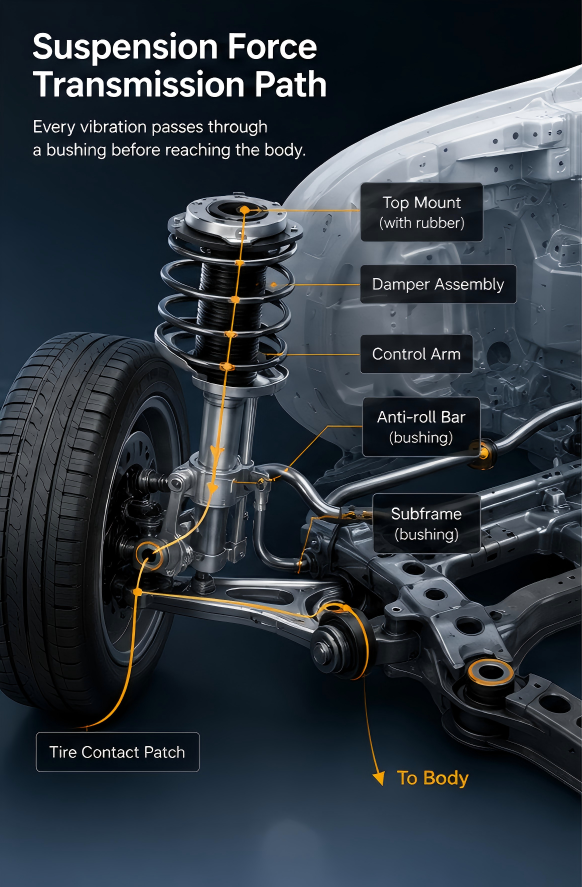
The spring sits on the damper assembly. The damper connects to the body through the top mount — which also has rubber in it. The control arms connect to the subframe. The subframe connects to the body through bushings. The anti-roll bar is mounted to the subframe via rubber bushings. Trace the force path from the tire contact patch to your seat, and the bushing is a link you cannot bypass. Every vibration coming off the road surface passes through a bushing before reaching the body.
So why does nobody talk about bushings? Because they look like nothing. A black rubber ring with an inner and outer steel sleeve — it looks like a washer. No precision valve stacks like a damper, no intuitive mechanical logic like a coil spring. But if its stiffness calibration is off by twenty percent, half the suspension tuning is wasted.
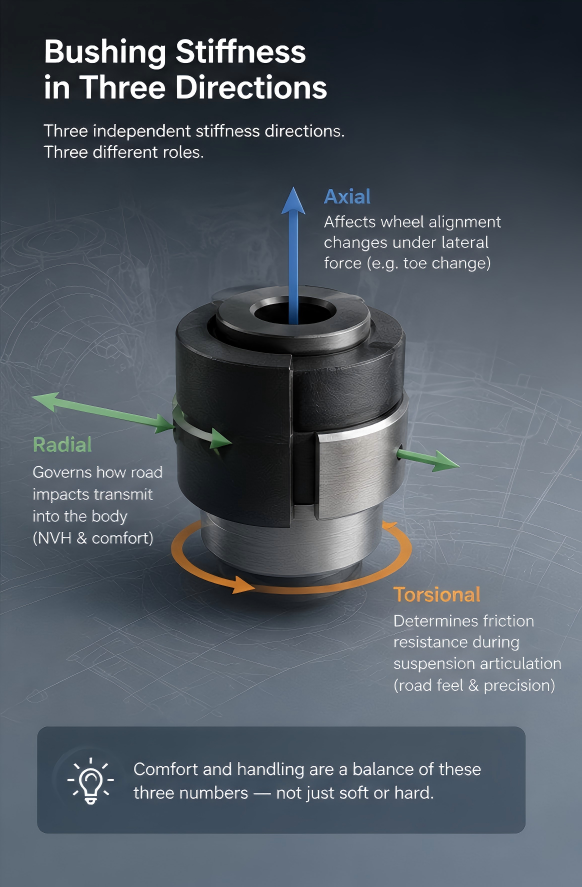
Let's get into what a bushing actually does. Most people think it's just a cushion — softer means more comfort, harder means more sport. That's way too crude. A bushing has three independent stiffness directions: radial, axial, and torsional. Radial governs how road impacts transmit into the body. Axial affects how much the wheel alignment angles shift under lateral force. Torsional determines how much friction resists suspension articulation. These three directions are not tuned in lockstep. On a premium car, a single bushing might go through a dozen iterations precisely because you're independently dialing in each axis to find the set of values where comfort and handling stop fighting each other.
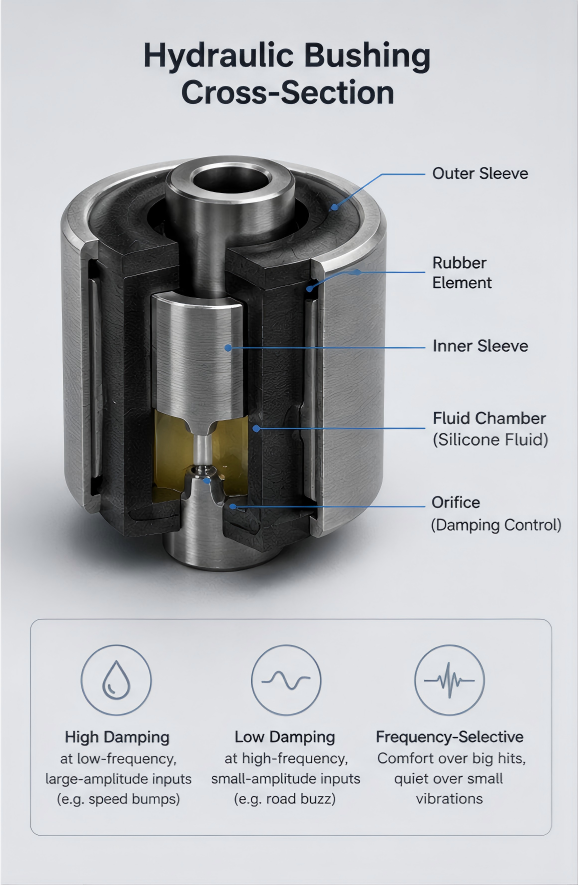
Hydraulic bushings are a different category. They add fluid chambers connected by an orifice that generates damping. Here's the key characteristic: high damping at low-frequency, large-amplitude inputs — like the moment you roll over a speed bump, fluid forced through that small hole creates hydraulic damping that absorbs most of the impact energy. And low damping at high-frequency, small-amplitude inputs — the constant buzz from rough pavement, where the bushing essentially gets out of the way and lets the rubber do the isolation. This frequency-selectivity is something a solid rubber bushing cannot deliver.
That's why a Mercedes S-Class or BMW 7 Series runs hydraulic bushings at the control arm pivot points. Not because they had money to burn. Because the physics of this design solves the contradiction between "absorb the big hit" and "stay quiet the rest of the time."
Another underrated aspect is handling. People think steering response is just springs and dampers — rubber has nothing to do with it. Wrong. When lateral force from the tires travels up the control arms to the subframe, if the rubber bushing deforms even a fraction of a millimeter in the axial direction, the toe angle of that wheel changes. And the moment toe angle changes, the yaw response of the entire vehicle shifts. When you drive a car that feels precise — direction responds instantly, the body follows right away — that's not just the steering rack calibration. It's the bushing's axial stiffness under lateral load, carefully matched. On a luxury car, this axial stiffness is dialed in with extreme care. Too low, and the steering feels vague. Too high, and road impacts come straight up through the steering wheel — your hands get fatigued on long drives.
Then there's torsional stiffness. When the suspension cycles up and down, the control arm rotates around its pivot point. If the bushing is too stiff in torsion, it adds drag to the suspension movement. The result? At small inputs, the suspension doesn't respond — road texture gets filtered out, the chassis feels numb and blunt. Too soft, and you lose kinematic precision. This torsional stiffness number is what determines whether that finest layer of road feel makes it through to the driver.
Now let's talk real-world use. In city commuting, the bushing mostly operates in the small-deformation zone — the rubber hasn't left its linear elastic range. At this stage, you won't notice a difference between a good bushing and a mediocre one. The gap opens up on rougher roads or when you're driving a bit harder. Pavement joints, bridge expansion gaps, broken concrete — these push the bushing into the transition zone where dynamic stiffness and damping angle both come into play. In an ordinary car, this is when the chassis starts feeling "thin." It's not the chassis that's thin — it's the bushing not fully absorbing the input, letting residual vibration through. Premium cars do this well not because the materials are that much more expensive, but because the calibration hours were paid for.
On the maintenance side, a few principles apply regardless of what you drive.
Bolts. The inner and outer steel sleeves of a rubber bushing are clamped by bolts, and the clamping force has tight tolerances. Many German cars use torque-to-yield bolts — tightened into the plastic region for precise preload. Once you remove them, the threads have already yielded. Reinstalling them won't achieve the design clamping force. That's a physical limit, not someone trying to sell you new bolts. Aluminum bolts especially: remove means replace.
Installation posture. I will never stop repeating this to workshops. A rubber bushing has exactly one neutral position — the angle it sits at when the vehicle is on the ground and the suspension is at design ride height. On a lift, the suspension hangs at full droop. If you tighten the bolts in that position, the bushing rubber is twisted from the very start — it carries a permanent preload angle. This torsional stress is constant; the rubber's molecular chains stay stretched indefinitely. A bushing that should last eighty thousand kilometers might fatigue-crack at thirty thousand if installed this way.
The correct procedure is simple: hand-tighten all bolts, lower the vehicle to the ground with wheels loaded, then torque to specification.
Check the neighbors. A control arm doesn't just have a bushing — it also has a ball joint. If the ball joint's dust boot tears, grit gets in, clearance grows, and eventually not only does the ball joint fail, but it pulls the bushing past its design deformation limits. Same with anti-roll bar end links — worn joints click over bumps, and many people mistake that for a strut mount. And crucially: if you've touched any suspension link's pivot point, the wheel alignment is off. That's geometry, not brand-specific. Skipping the alignment makes the whole job pointless.
⚠️ A word on polyurethane. PU bushings are harder, resist deformation better, and have their place — on track. The tradeoff on the street? Isolation capability an order of magnitude worse than rubber. Rubber can achieve a damping angle in the teens; polyurethane barely registers a fraction of that. High-frequency road inputs come through almost undamped — steering wheel vibration, floor panel buzz, cabin drone. And PU squeaks against metal — you'll be disassembling things regularly to apply specialized grease. If you've got a flagship luxury sedan — 7 Series, S-Class, A8, LS — my position is firm: don't touch it.
Low temperature behavior. Rubber is temperature-sensitive. Below about minus ten Celsius, the elastic modulus can double. Cold start, first few kilometers — those low thuds from the suspension are mostly the bushings stiffened up, making noise during articulation. Ten or fifteen minutes of tire-generated heat conduction and the sound disappears. That's physics, not a fault. But if the same noise persists in warm weather, the rubber is genuinely aged or debonded. Time for the lift.
Replacement interval. There's no absolute number — depends on load, road conditions, driving style. As a rule of thumb: sixty to a hundred thousand kilometers, or five to eight years, is the window where a thorough inspection should happen. You don't need fancy diagnostic gear. A pry bar at each pivot point to check for play, a visual check for surface cracking on the rubber — that's enough. The driver can also feel the signals: more oscillation after speed bumps than before, deeper nose-dive under hard braking, delayed body response during lane changes at speed, feathering wear pattern on the tires. Any one of those — check the bushings first.
I say this a lot: bushings are among the cheapest components in the entire chassis system. But when they go, they take down parts that cost several times — sometimes dozens of times — more: damper oil seals, air spring bladders, top mount bearings, tires. It's not a "replace when broken" consumable. It's a "check on schedule, don't settle if it's done" maintenance discipline. Chassis refinement — that final layer of quality you feel on every drive — ultimately rests on a handful of rubber rings. You can spend whatever you want on dampers and springs. If the bushings are shot, none of it matters.