Think about this for a second. Take the same suspension architecture — put it in a sports sedan and in an executive cruiser — and the two cars feel completely different. Springs and dampers differ, sure. But there's an invisible variable that plays a decisive role: the bushing.
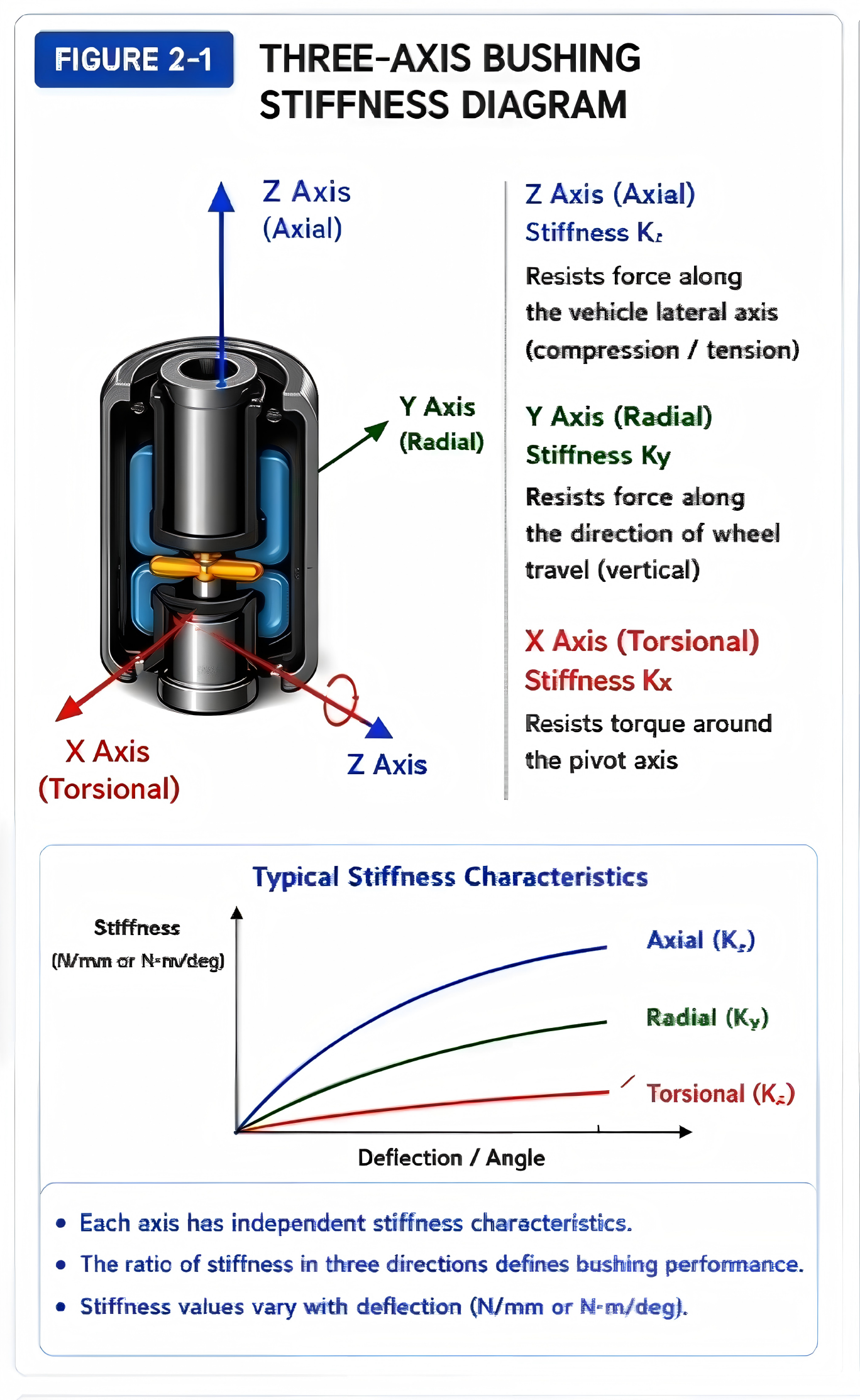
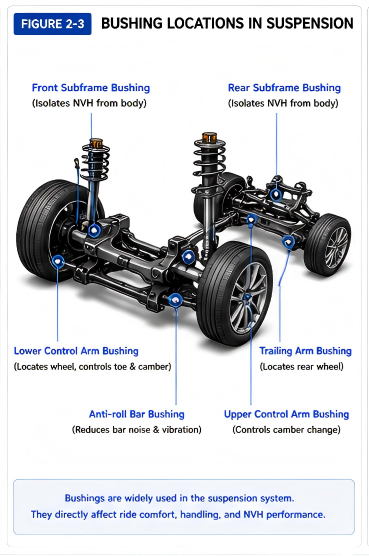
What's a bushing? The rubber connector at every pivot point where suspension links — control arms, subframes, anti-roll bars — attach. It doesn't look like much. A palm-sized chunk of black rubber. But its hardness, its damping characteristics, the ratio of stiffness across three independent axes — that's what decides whether a car feels supple or sharp, precise or relaxed.
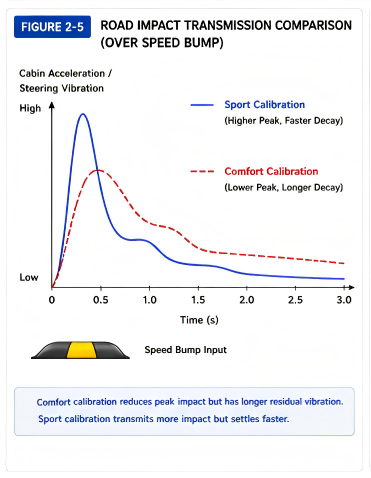
I 've spent years in chassis tuning, and here's something I've learned: springs and dampers define the car's "skeletal character." Bushings define its "skin feel." The skeleton determines whether the car is functional. The skin determines whether it's good — whether it's comfortable, whether it's satisfying. And what the user ultimately feels is the skin, not the skeleton. Drive over a pavement joint — how the impact transmits, how much of it comes through, how long the residual oscillation lasts afterward — those details aren't decided by the spring. They're decided by the bushing.
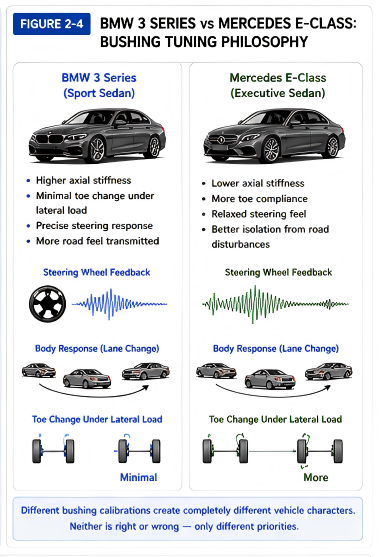
Let me give you a concrete example. Take a sports-oriented midsize sedan — say a BMW 3 Series — and an executive saloon — say a Mercedes E-Class. The lower control arm bushing calibration on these two cars follows entirely different philosophies. The 3 Series runs a higher axial stiffness. Under lateral load, the toe angle change is minimal, so the steering is precise — the body responds instantly to a lane change, giving the driver a sense that the car follows intent. The tradeoff? Road irregularities tug at the steering wheel somewhat. Your hands can't completely relax. The E-Class goes the other way: lower axial stiffness, allowing a slightly softer toe response under lateral load. The steering wheel filters out road disturbance almost entirely. It's relaxed, effortless. The tradeoff? Steering isn't quite as razor-sharp. Two calibrations, neither right or wrong — just different priorities. But swap the 3 Series bushings into an E-Class, and the car's entire personality shifts. And vice versa.
That's exactly why I say a piece of rubber defines a car's character. Character is hard to quantify. It's not zero-to-sixty, it's not braking distance. But it determines the first impression a driver registers on every single drive — "this car handles beautifully" versus "this car rides beautifully." And that first impression, to a large degree, comes from the finest layer of mechanical signals the bushings pass through to the driver.
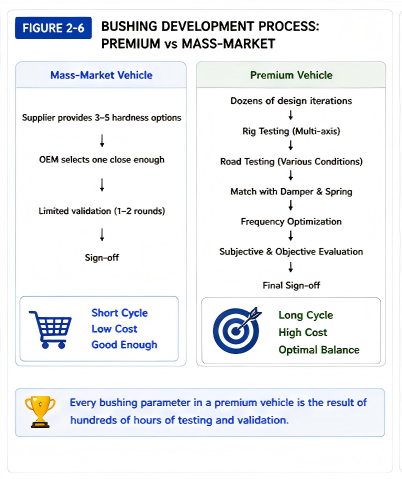
The investment premium cars make in bushings is invisible to most people. A volume-market car might do two rounds of bushing calibration — the supplier offers three or five hardness options, the OEM picks one that's close enough, and they sign off. A premium car can't work that way. One control arm bushing going through a dozen or more iterations is routine. Radial stiffness, axial stiffness, torsional stiffness — curves pulled on all three axes, cross-matched against the damper's force-velocity curve, against the spring rate, against the vehicle's natural frequency. Just the orifice diameter in a hydraulic bushing might go through dozens of sample variants — a fraction of a millimeter too large and low-speed damping is insufficient; too small and high-speed impact feels harsh. The final parameter set that gets signed off represents hundreds of hours on the rig and on the road.
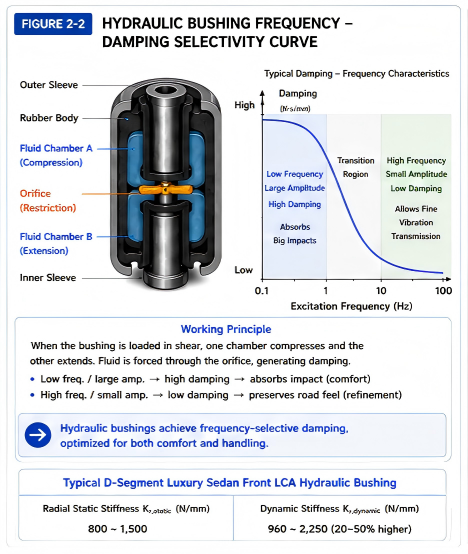
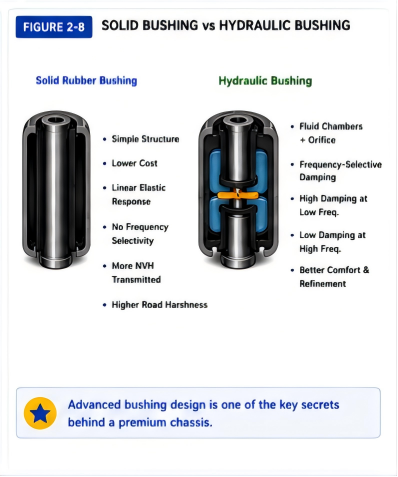
Hydraulic bushings are worth expanding on. A solid rubber bushing is a passive elastic element — force comes in, it deforms, force leaves, it rebounds. A hydraulic bushing has internal fluid chambers connected by an orifice. When the bushing is loaded in shear, one chamber compresses, the other expands, and fluid is forced through that small hole. The beauty is in the frequency selectivity: high damping at low-frequency, large-amplitude inputs — absorbing the big hit from a speed bump; low damping at high-frequency, small-amplitude inputs — not amplifying fine-texture road vibration. This characteristic is impossible to achieve with solid rubber alone. It's essentially embedding a miniature damper inside the rubber bushing — a damper that only operates on a specific frequency range. In engineering terms, that's a genuinely elegant solution. One component solving two contradictory requirements.
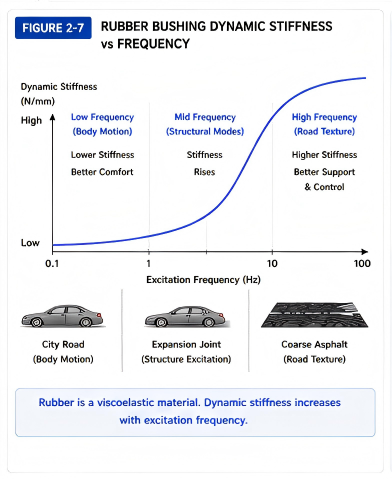
There's another thing people don't often discuss: dynamic stiffening. Rubber is a viscoelastic material — its stiffness isn't constant; it varies with excitation frequency. The higher the frequency, the greater the dynamic stiffness. This behavior isn't a defect — it's designed in. At highway speeds, road excitation frequency is high, so the bushing naturally becomes stiffer, providing better lateral support exactly when you need it for stability. At low speeds, frequency is low, the bushing is relatively softer, preserving comfort. In effect, rubber bushings have an inherent "adaptive" stiffness characteristic that requires zero electronic control. So when you drive a car that feels compliant around town and stable at speed, some of that credit goes to the bushing's dynamic stiffening, quietly doing its job.
But this same characteristic creates a trap. Some people, chasing sharper handling, swap out the factory rubber for polyurethane, assuming harder equals better handling. It's not that simple. Polyurethane has a much lower damping angle than rubber, and its dynamic stiffening characteristics are entirely different. You've essentially replaced a carefully calibrated component with a material whose damping behavior is fundamentally different. The result is usually: yes, turn-in is a fraction sharper, but the entire NVH budget collapses — steering wheel vibrates, cabin drones, and a collection of creaks and groans appears. The trade is rarely worth it. Unless the car is dedicated to track days and barely sees the street, polyurethane has its place. But for daily commuting, weekend family duties — leave it alone.
I should also say what I always say. No matter what you drive, bushings age. Rubber reacts with atmospheric ozone, surfaces gradually develop micro-cracks. The vulcanized molecular structure fatigues under repeated stress, elasticity declines. When replacement time comes, stick to a few principles: replace the bolts, don't cheap out on those few dollars; the vehicle must be on the ground when final torque is applied, don't let someone tighten it on the lift; after touching any suspension pivot point, a full wheel alignment is mandatory; use OEM bushings where possible — the hardness deviation on aftermarket parts can be large enough to drop your chassis down an entire class.
Bushings are that kind of component — looks cheap, but failing to replace them on time costs a lot; looks simple, but a tiny calibration deviation and the entire feel changes. The "premium feel" of a car, when you break it down, is an accumulation of countless micro-details. The bushing is the easiest one to overlook — and the one you can least afford to.