If you're willing to go down this rabbit hole with me, let's walk through the numbers on suspension bushings. No adjectives — no "solid feel" or "precise handling." Just how forces travel, how deformation happens, and how the data connects to what the driver perceives.
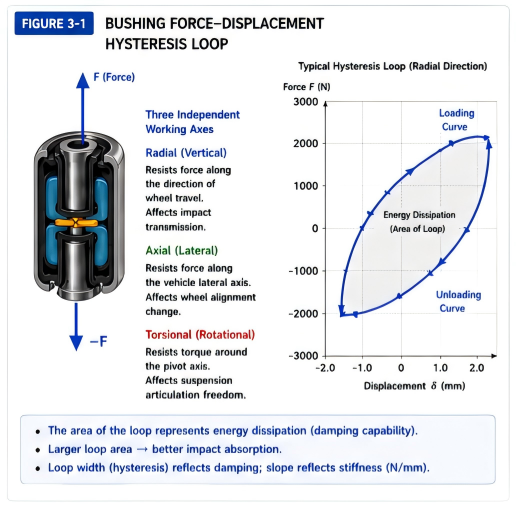
Frame the problem first. A suspension bushing, in engineering terms, is not isotropic. It has three independent working axes. Radial — along the direction of wheel travel, governing impact transmission. Axial — along the vehicle's lateral axis, governing alignment change under cornering loads. Torsional — around the pivot axis, governing suspension articulation freedom. These three stiffness values are independently specified during development. They don't derive from a single hardness number.
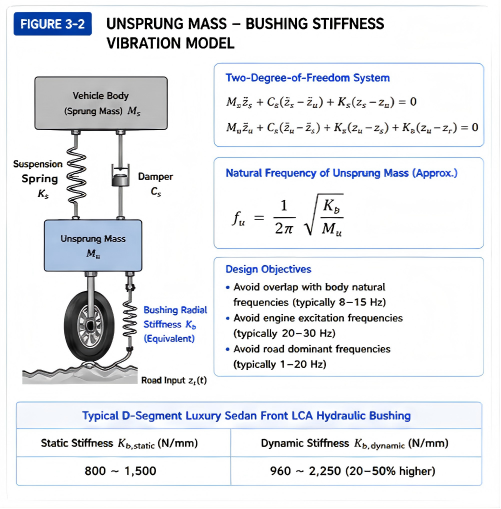
The first number to look at is radial stiffness. Take a D-segment luxury sedan's front lower control arm hydraulic bushing. Its radial static stiffness might land somewhere in the 800 to 1,500 N/mm range. Where does that number come from? It's back-calculated from the unsprung mass resonance frequency. The unsprung mass — tire, wheel, brake disc, a portion of the control arm — is a few dozen kilograms. It forms a mass-spring system with the bushing's radial stiffness. If this system's natural frequency coincides with a body bending mode or with engine idle excitation, you get a cabin boom that no amount of deadening will fix. So the bushing's radial stiffness must be set precisely to avoid every known structural mode and excitation frequency in the vehicle. And that's just static stiffness. Dynamic stiffness — the stiffness rubber exhibits under dynamic loading — runs 20 to 50 percent higher than static, depending on the rubber compound and excitation frequency. During calibration, you're pulling curves for both, not a single data point.
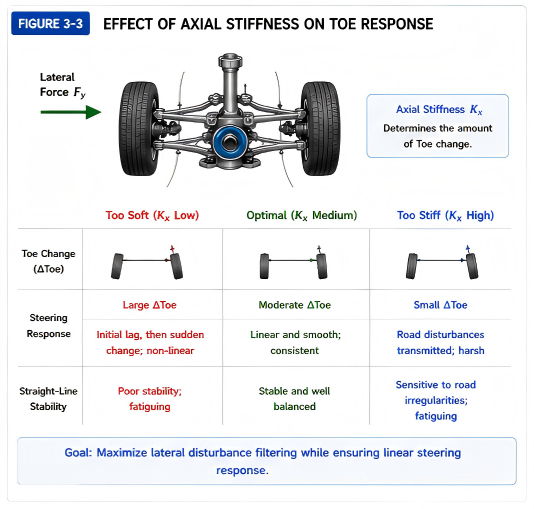
The axial stiffness calculation is more involved. When a tire generates lateral force — during cornering, from crosswinds, from road camber — that force travels through the suspension links to the subframe. If the bushing's axial stiffness is insufficient, the toe angle changes under load. When toe angle changes, the yaw rate response of the vehicle changes. You turn the steering wheel expecting a linear buildup of cornering force; if the bushing is too soft, the first portion of steering input feels dead — because the lateral force hasn't yet built up enough to take up the bushing deformation — and then it suddenly sharpens. This nonlinear steering response seriously undermines driver confidence. On the other extreme, too stiff and every minor lateral disturbance from uneven pavement feeds directly into the steering wheel — your hands tire out on a long highway cruise. So luxury cars spend enormous time on this parameter: the goal is to maximize lateral disturbance filtering while guaranteeing linear steering response. Achieving that isn't about exotic materials. It's about iterating on axial stiffness values — test after test, subjective evaluation alongside objective measurement — until you find the narrow window that satisfies both conditions simultaneously.
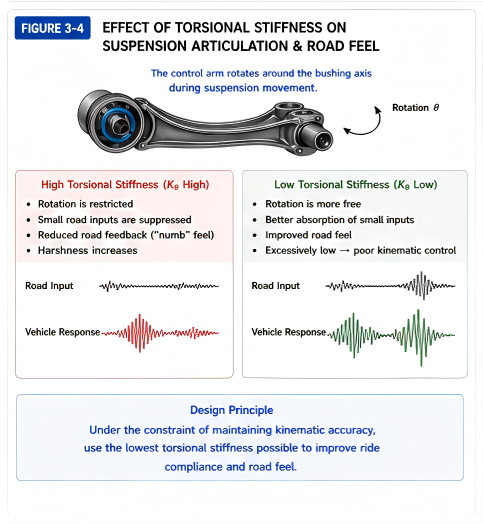
Torsional stiffness. When the suspension cycles, the control arm rotates around its pivot. If the bushing's torsional stiffness is too high, this rotation meets resistance. This manifests most clearly at small amplitudes — microscopic road texture demands high-frequency, small-amplitude suspension response, but if the bushing can't rotate freely, that movement is suppressed. The felt result is a chassis that's "numb" or "blunt" — road information getting cut off. But you can't go too low either, because then kinematic precision degrades — track width, camber, toe deviate too far from design targets through the suspension stroke, compromising tire contact. So torsional stiffness is also a precise balance: as low as possible while still maintaining kinematic accuracy. Premium cars tend to be more exacting here — a volume car might stop at "kinematics are within tolerance," while a luxury car pushes the torsional stiffness a bit lower still, chasing that last increment of ride suppleness and surface delicacy.
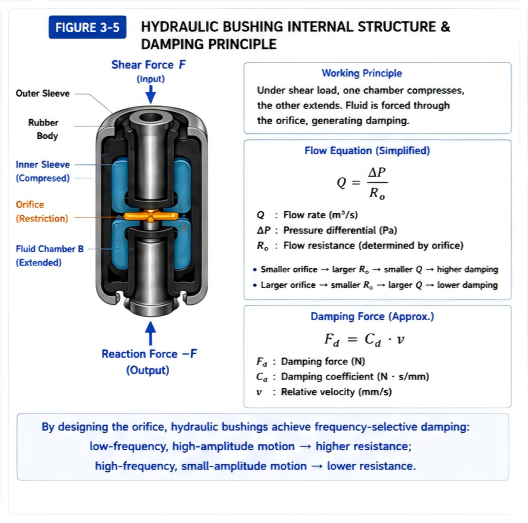
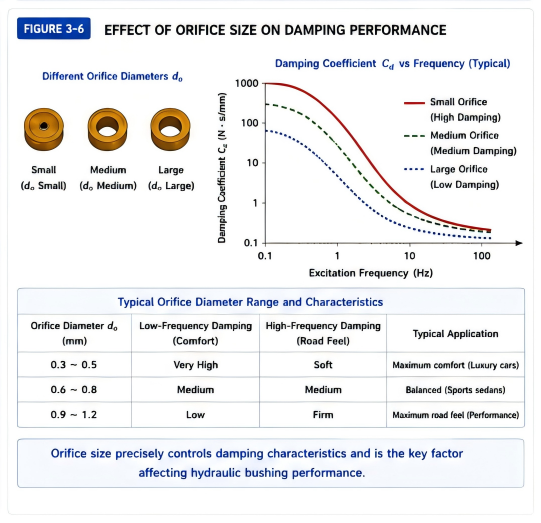
The hydraulic bushing deserves its own chapter of math. The internal structure has two fluid chambers connected by an orifice. When the bushing is loaded in shear, one chamber compresses, the other expands, and fluid is forced through the orifice. The fluid dynamics principle: flow rate is proportional to pressure differential, inversely proportional to flow resistance. A smaller orifice means higher flow resistance — for a given pressure, less flow, meaning slower deformation under a given force. That's higher damping. A larger orifice, the opposite, less damping. What does this damping magnitude determine? It determines how quickly impact energy gets dissipated.
Specifically: a well-tuned hydraulic bushing, subjected to a step force input — like rolling over a speed bump — produces a response curve where displacement rises quickly to peak, then returns to zero in minimal time with no secondary overshoot. A solid rubber bushing, same input: higher peak displacement, and the rebound includes several decaying oscillations — that's the "aftershock" you feel. A poorly tuned hydraulic bushing from the aftermarket: either the damping is too aggressive and the impact feels unnecessarily harsh, or the damping is too weak and you get more oscillation than stock. That's why almost no aftermarket hydraulic bushing works properly — nobody did the fluid passage calibration. The orifice diameter and fluid viscosity are essentially random. Install one, and the chassis either goes harsh or wallowy. It's never at that exact optimal point the OEM found.
Here's another calculation that's easy to overlook: bushing stiffness is coupled with the vehicle's ride natural frequency. Ride comfort is heavily influenced by the sprung mass natural frequency — typically in the 1 to 1.5 Hz range. This frequency is primarily set by spring rate and sprung mass, but the bushing's series stiffness affects it. Because the bushing is in series with the spring along the force path — the softer the bushing, the lower the total system stiffness, and the natural frequency drops. Swap in a softer bushing, and the vehicle's natural frequency shifts downward slightly. Maybe nobody consciously feels a fraction of a hertz, but during development, this coupling is fully accounted for.
Let me close with the most practical math of all: the cost of deferred bushing replacement. An OEM front lower control arm bushing — the part itself might run a few hundred dollars, labor maybe another few hundred to a thousand. Skip the replacement. The rubber continues fatiguing until it fully debonds. Now you've got metal-on-metal contact. The control arm's pivot bore gets wallowed out — control arm is scrap. Impact loads travel straight up undamped. The damper's oil seal gets hammered by high-frequency spikes — damper is scrap. If it's an air suspension car, the air spring bladder fatigues faster under the additional impact loading — an air strut assembly runs several thousand, possibly over ten grand. Add it up. Saving a couple hundred on a bushing can generate a repair bill in the tens of thousands. This isn't alarmist. Fleet maintenance data validates it over and over.
So here's the bottom line. Suspension bushing math boils down to a handful of keywords: three-axis independent stiffness calibration, hydraulic damping frequency-selectivity, dynamic stiffening curve matching, coupling with the vehicle's natural frequency, and the cascade cost of aging. It's a part that looks dead simple and calculates out incredibly complex. Fortunately, as a vehicle owner, you don't need to crunch any of this. You just need to know two things: don't use aftermarket, and when the interval is up, inspect and replace if needed. Leave the rest to the data.