Most car owners see a suspension bushing as just a rubber washer. Same category as wiper blades and brake pads — a consumable. When it breaks, you replace it. That way of thinking is fundamentally wrong.
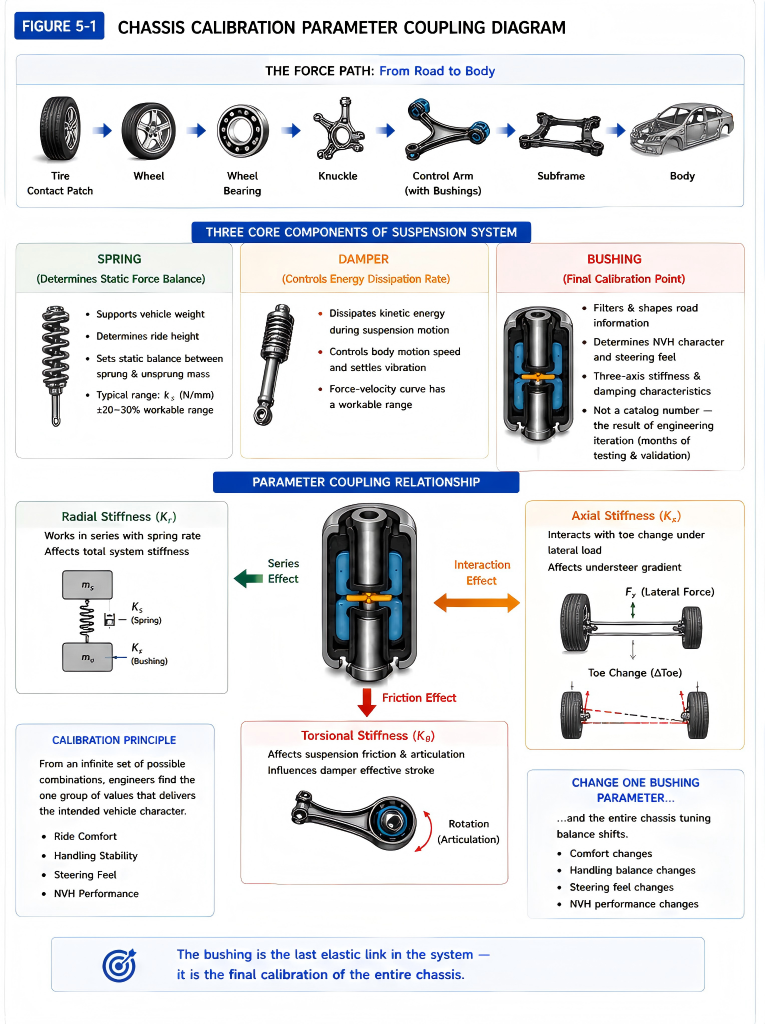
A bushing is the last calibration point in the entire suspension system. Here's what I mean. Start at the tire contact patch. Force travels upward: through the wheel, the wheel bearing, the knuckle, the control arm, the subframe, and finally into the body. Along this path, the spring determines the static force balance between sprung and unsprung mass. The damper determines the rate at which kinetic energy gets dissipated during motion. And the bushing — this last elastic link — determines the exact character with which road information presents itself to the driver and passengers. You can buy springs and dampers as off-the-shelf products with specifications printed on a data sheet. But a bushing's stiffness curves, its damping angle, the three-axis stiffness ratio — those aren't catalog numbers. They're what a chassis engineer arriving at work for months on end, iterating between road tests and rig data, slowly grinds into existence. It's not a generic commodity. It's the terminal of the vehicle's chassis calibration.
What does "calibration" mean here? It means that from an infinite set of possible parameter combinations, you find the one group of values that makes the car exhibit exactly the character the engineers intended. Spring rate has a workable range. Damper force-velocity curves have a workable range. Bushing three-axis stiffness and hydraulic damping characteristics have a workable range. These three ranges don't exist independently — they're cross-coupled. A bushing's radial stiffness sits in series with the spring rate, affecting total system stiffness. Its axial stiffness interacts with the toe-angle change rate under lateral load, which in turn affects the vehicle's understeer gradient. Its torsional stiffness affects suspension friction, which affects how effectively the damper uses its available stroke. Change one bushing parameter, and the entire chassis tuning balance tips.
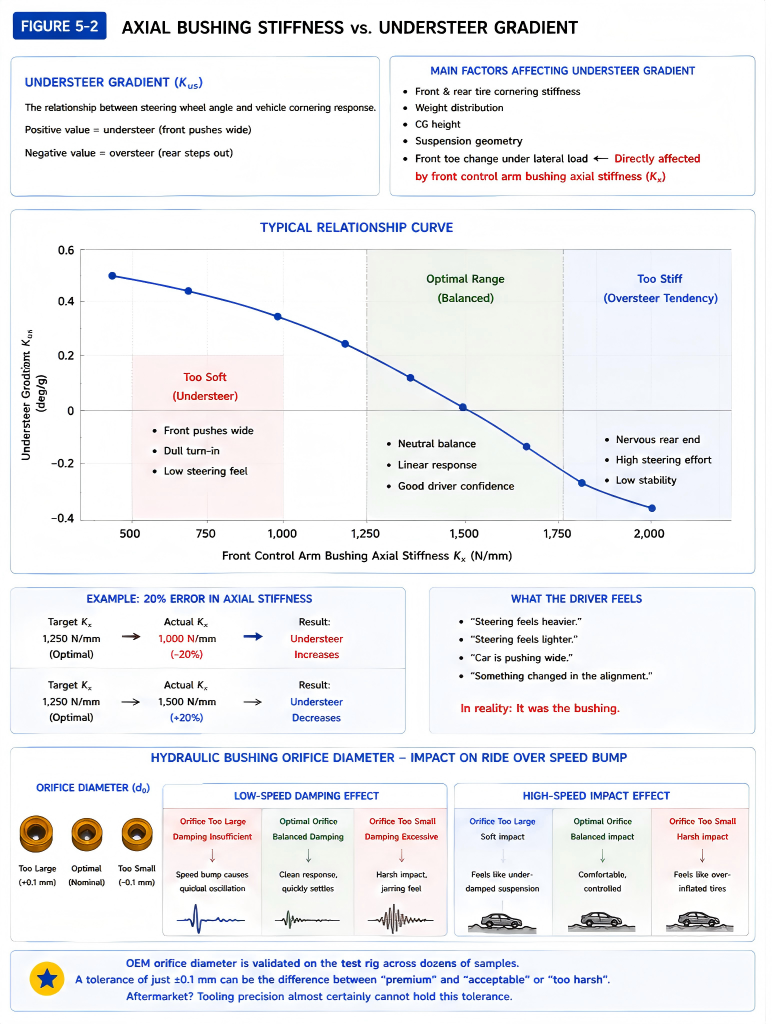
Let me give you a concrete example. A vehicle's understeer characteristic — the relationship between steering wheel angle and how much the car actually turns into a bend — is one of the most important subjective metrics in chassis tuning. Too much understeer, the car resists turning in, feels dull. Too little, the rear feels unsettled, driver confidence evaporates. The understeer gradient is determined by many factors combined. One of them is the change in front toe angle under lateral load. And that toe change directly depends on the front control arm bushing's axial stiffness. If this stiffness is off by twenty percent, the vehicle's entire understeer gradient shifts. The driver feels "the steering got lighter" or "the steering got heavier" or "the car is pushing a bit." He assumes something changed in the steering calibration. It was the bushing.
Another example. The orifice diameter in a hydraulic bushing — a hole measuring fractions of a millimeter — its tolerance directly determines what you feel going over a speed bump. Bore it a tenth of a millimeter too large, low-speed damping is insufficient, and the speed bump leaves residual oscillation. Bore it a tenth too small, high-speed impact turns harsh — that same bump feels like you're running over-inflated tires. A tenth of a millimeter is the difference between "premium" and "acceptable" or "a bit harsh." The OEM part's orifice was verified on the rig across dozens of samples. Aftermarket? I'm sorry, but aftermarket tooling precision almost certainly can't hold that tolerance.
So now you understand why I bristle at the idea of treating a bushing as a consumable. The consumable logic is: "it broke, replace it with whatever, as long as it works." The bushing logic is: "it's the final calibration point of the chassis — replacing it isn't fixing it unless you replace it with the right thing." Swapping a bushing is, at its core, restoring the vehicle's original chassis calibration state. It's not just replacing a broken part. That cognitive difference — that's the dividing line between an ordinary car owner and someone who actually understands the vehicle.
Why can a bushing take on the role of "calibration terminal"? Because it sits at the point in the force path closest to the body. Road vibration travels up from the tire: through the wheel, bearing, knuckle, control arm — all metal parts, enormous stiffness, negligible energy attenuation. At the bushing, the elastic modulus of rubber is orders of magnitude lower than steel. The force finally encounters a soft link. It's the lowest-stiffness component in the entire suspension force path, which means it's also the component that contributes the most to attenuating force along the entire transmission chain. This position is what gives it its calibration authority — not because it's expensive, but because its location in the mechanical path means it has the final say.
The calibration investment premium cars make in bushings is something ordinary consumers have trouble grasping. A single hydraulic bushing, from design freeze to production sign-off, might go through over a dozen — sometimes several dozen — rounds of rig testing and vehicle road testing. Each round, the engineer goes back and forth between objective data — force-displacement curves, damping-angle-versus-frequency curves, dynamic stiffness curves — and subjective evaluation — speed bump feel, washboard road feel, high-speed lane-change feel — adjusting rubber formulation, vulcanization parameters, orifice dimensions, until the objective data lands within the target window and the subjective evaluation passes. This process isn't so much tuning as it is calibrating. And the final set of parameters that gets signed off isn't "the best" — because there's no global optimum in chassis tuning. It's the set that "exactly matches this vehicle's intended character."
This also explains why a car's chassis refinement collapses when non-OEM bushings are installed. It's not that the aftermarket material is necessarily inferior — some aftermarket suppliers may use rubber compounds as good as the OEM's. It's that they didn't do the matching. They don't have the vehicle's calibration data. They don't know the target toe-angle change rate, the vehicle's target natural frequency, or the exact orifice dimension required to match the damper's force-velocity curve. They're manufacturing a rubber component, not calibrating a chassis system.
So what can you do, as an owner, with this perspective?
First, when selecting parts, don't just look at the price. Part of what you pay for an OEM bushing is mold amortization, part is brand markup — but part genuinely represents the calibration cost embedded in it. Understand that you're not just buying a piece of rubber. You're buying the parameter set that a group of engineers spent hundreds of hours of testing to lock down.
Second, when installing, make sure the procedure is correct. If the installation process is wrong — tightened on the lift, bolts reused, no alignment afterward — then even with genuine OEM parts, the result won't match the design. Installation is the final step of calibration. Get this step wrong, and every calibration achievement preceding it is wasted.
Third, don't casually change the compound. Polyurethane bushings, reinforced rubber bushings — there are plenty of "upgrade" options on the market. If your car is a daily driver with occasional spirited use, my personal advice: don't touch them. The OEM rubber bushing's stiffness, damping, and three-axis ratio are balanced across all the use cases you actually encounter. Polyurethane is for track or near-track environments. Blindly "upgrading" is you, personally, destroying the OEM chassis calibration, in exchange for a performance gain you might use twice a year — while every day, you endure NVH that's materially worse than before.
Fourth, move your inspection schedule forward. Don't wait until the bushing has failed. Sixty to eighty thousand kilometers, or four to five years — whether there are symptoms or not, get the bushings checked. The cost of one inspection is negligible. It can prevent a cascading repair bill of entirely different magnitude.
Let me close with how I characterize this: suspension bushings are the physical realization of a vehicle's chassis calibration. You paid for a certain level of chassis refinement. A meaningful portion of what you paid sits in a handful of palm-sized rubber components. The bushing is not a consumable. It's the last link in the chain of refinement you feel on every commute, every lane change, every speed bump. Respect it, and it returns that respect with the finest chassis quality it can deliver. Treat it as a disposable, swap it with whatever's cheap — and it won't be polite about the consequences.